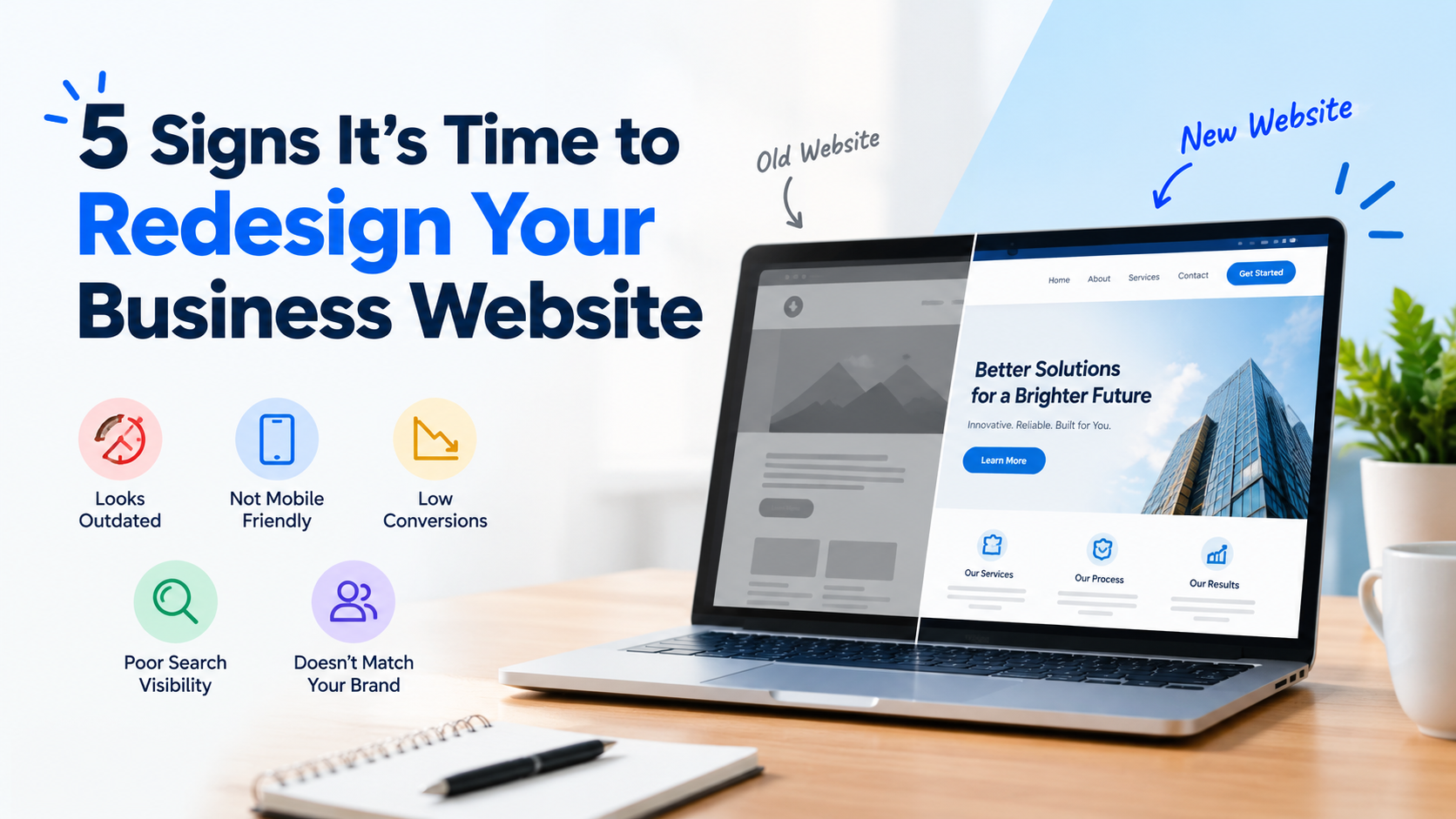
Not every website problem needs a full redesign. Sometimes a few tweaks — faster images, a clearer headline, a working contact form — are all you need. But there’s a difference between a website that needs fixing and one that needs rebuilding. Knowing which one you’re dealing with saves you time, money, and a lot of frustration.
Here are five honest signs that your website has crossed that line — and it’s time to start fresh.
1. You’re Embarrassed to Share Your Own Website
This is the simplest test, and usually the most accurate one. If you hesitate before sending someone your website link — or quietly hope they don’t scroll too far — that’s not a small issue. That instinct is usually right.
A website is often the first real interaction someone has with your business. If it doesn’t reflect how far your business has actually come, it’s actively working against you, not for you.
What this usually means: Your business has grown, but your website hasn’t kept up with it.
2. It Was Built More Than 4-5 Years Ago and Never Touched Since
Web design trends move fast, but more importantly, user expectations move fast. A site built five or more years ago was likely designed for smaller screens, slower connections, and different browsing habits than what your customers have today.
Beyond visuals, older websites often carry outdated code that loads slowly, doesn’t work well on modern phones, and isn’t structured the way search engines now expect. Even if it “still works,” it’s quietly losing ground every month.
What this usually means: The foundation is outdated, not just the design on top of it.
3. You Can’t Update It Yourself
If every small change — a new phone number, an updated price, a fresh testimonial — requires calling a developer, waiting days, and paying extra, your website is holding your business back operationally, not just visually.
A modern website should let you (or anyone on your team) make basic updates in minutes, without needing to touch code.
What this usually means: Your current platform wasn’t built with flexibility in mind — a redesign is a chance to fix that structurally, not just cosmetically.
4. Your Competitors’ Websites Feel More Trustworthy
Take five minutes and look at two or three competitors’ websites, as if you were a customer meeting your industry for the first time. Be honest — whose website would you trust more with your money?
If competitors look more current, more credible, or simply easier to use, customers comparing you side-by-side are noticing the same thing — even if they never tell you.
What this usually means: Your website is quietly costing you comparisons you don’t even know you’re losing.
5. Traffic Comes In, But It Doesn’t Convert
This is the clearest business signal of all. If people are finding your website — through Google, ads, or social media — but very few of them call, message, or buy, the problem usually isn’t your marketing. It’s what happens after someone lands on the page.
Confusing navigation, unclear offers, slow load times, or a design that doesn’t build trust can quietly cancel out everything you’re spending to get visitors there in the first place.
What this usually means: You’re paying to bring people to a door that isn’t opening properly.
So, Repair or Redesign?
Here’s a simple way to decide:
- If your website has one or two specific problems (slow images, one broken page, outdated contact info) — that’s a fix, not a redesign.
- If you’re nodding along to three or more signs above — that’s usually a sign the whole structure needs rebuilding, not patching.
A redesign isn’t just about looking modern. Done right, it’s about removing every small reason a potential customer might hesitate, scroll away, or choose someone else instead — and replacing that hesitation with confidence.
Not sure which camp you’re in? A short website review can usually tell you within minutes whether you need a quick fix or a fresh start.